Address validation tokens - what are they good for anyway?
by Rüdiger KlaehnQUIC is not a simple protocol. Most, possibly all of the complexity is there for a good reason. It's a distillation of decades of experience with real world traffic on the internet. But still it can be daunting sometimes.
Part of the complexity is various mechanisms where one side sends opaque data to the remote that is to be presented in a subsequent packet. Another very complex part is throttling.
During preparation for 1.0 we went over all features of iroh and noq, including some that you rarely interact with as a user. This blog post explains a mechanism that touches both of these topics.
Anti-amplification
Unlike simpler protocols, QUIC tries very hard to be a good internet citizen and prevent amplification attacks. It must not be possible to get a powerful server running a QUIC endpoint to send a lot of data to an unrelated endpoint.
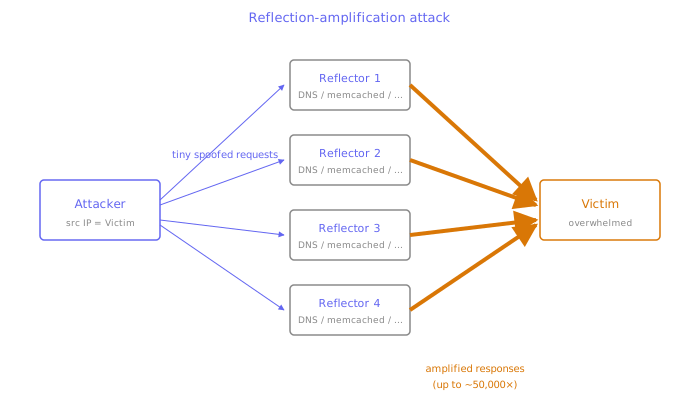
So as long as we have not validated the IP address of the remote, we are only allowed to send a tiny trickle of data to the remote address. To be precise, 3x the amount of data we seemingly received from the remote address.
For a typical initial ClientHello, the server receives 1200 bytes (the initial packet is padded to 1200 bytes), so it is allowed to send 3600 bytes.
The factor of 3 is an educated guess for a value that is small enough to make QUIC unattractive for amplification attacks while allowing the protocol to work. Other commonly used protocols have much bigger factors:
- DNS: ~50× — deep dive on DNS amplification
- NTP (monlist): ~556× — behind the 400 Gbps Cloudflare attack in 2014
- memcached: up to ~50,000× — behind the 1.35 Tbps GitHub attack in 2018
What do we have to send, and can this be a problem?
The absolute minimum we need to send in these 3600 bytes is the ServerHello. Without that, the client can't proceed in the handshake and we would be stuck.
Fortunately the ServerHello is almost guaranteed to fit in 3600 bytes. The only big variable size thing it contains is information for the key exchange, and that is as of now always comfortably below 3600 bytes.
With some large post-quantum key exchanges we might exceed the 3600 bytes even for the ServerHello. For example, HQC-128, NIST's backup KEM, has a ~4 KiB ciphertext.
But ideally we want to send the entire server response in 3600 bytes. If we can only send the ServerHello but not the rest, we are not stuck, but stalled. We will have to wait for a packet from the client that is encrypted with the session key to remove the limit, which means another roundtrip.
This, unfortunately, can happen even today. For traditional client/server QUIC connections the rest of the server response to the initial ClientHello includes the entire certificate chain. A short chain solely consisting of ECDSA certificates comfortably fits, but e.g. a chain containing multiple RSA-2048 certs does not.
Once you go to post-quantum signatures, even a single ML-DSA-65 won't fit, and a typical chain will be much larger.
There are also extensions that might push the server response over 3600 bytes.
Trying it out.
To try this out I wrote a small noq demo that just connects to publicly available servers and logs the interaction in qlog format. None of this is specific to noq, it is a QUIC mechanism.
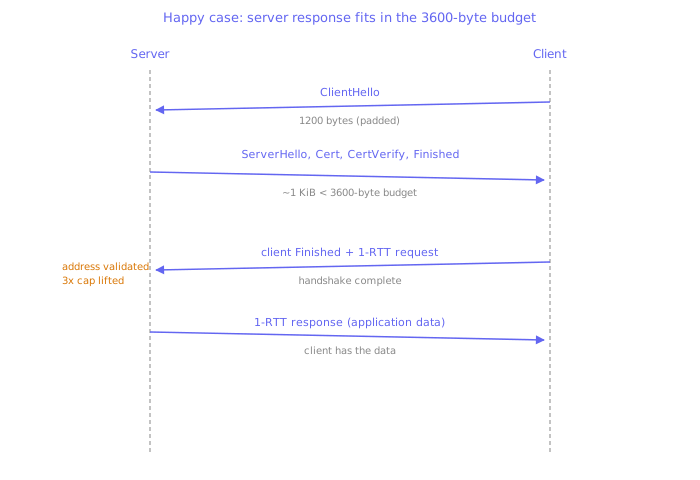
A real handshake that fits, against www.cloudflare.com. Every same-direction packet gap is sub-20 ms; the server's handshake packets arrive in one tight burst.
| time (ms) | Δ same dir | dir | space | pn | size |
|---|---|---|---|---|---|
| 32.49 | — | send | initial | 0 | 1200 |
| 51.16 | — | recv | initial | 0 | 155 |
| 51.16 | + 0.00 | recv | handshake | 1 | 1200 |
| 51.38 | + 18.89 | send | initial | 1 | 60 |
| 51.38 | + 0.00 | send | handshake | 0 | 1140 |
| 54.02 | + 2.86 | recv | handshake | 2 | 1200 |
| 54.02 | + 0.00 | recv | handshake | 3 | 835 |
| 54.78 | + 3.40 | send | handshake | 1 | 115 |
| 54.78 | + 0.00 | send | 1RTT | 0 | 1326 |
| 57.17 | + 2.39 | send | 1RTT | 1 | 102 |
| 72.20 | + 18.19 | recv | 1RTT | 4 | 573 |
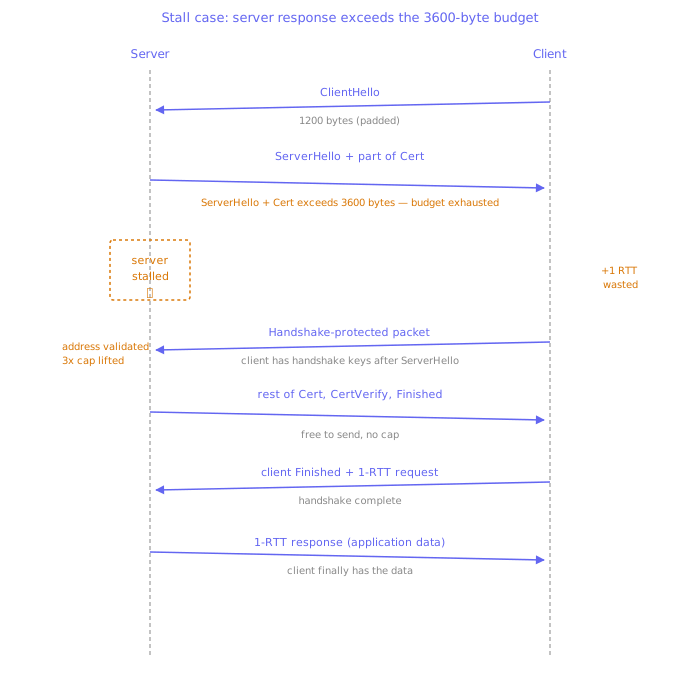
A real handshake that stalls, against quic.aiortc.org. The server sends three Handshake-space packets back to back, hits the 3600-byte cap, and pauses — visible as the +63.14 ms gap on the recv handshake 4 row, exactly one RTT to aioquic.
| time (ms) | Δ same dir | dir | space | pn | size |
|---|---|---|---|---|---|
| 34.67 | — | send | initial | 0 | 1200 |
| 103.71 | — | recv | initial | 0 | 144 |
| 103.71 | + 0.00 | recv | handshake | 1 | 1056 |
| 103.89 | + 69.22 | send | initial | 1 | 48 |
| 103.89 | + 0.00 | send | handshake | 0 | 1152 |
| 107.55 | + 3.83 | recv | handshake | 2 | 1200 |
| 107.57 | + 0.03 | recv | handshake | 3 | 1200 |
| 110.99 | + 7.10 | send | handshake | 1 | 48 |
| 170.71 | +63.14 | recv | handshake | 4 | 1200 |
| 170.78 | + 59.79 | send | handshake | 2 | 47 |
| 175.02 | + 4.31 | recv | handshake | 5 | 110 |
| 175.02 | + 0.00 | recv | 1RTT | 6 | 153 |
Does this even matter for iroh?
But wait a minute! Iroh is not sending certificate chains, but just a single Ed25519 public key in the raw public keys in TLS extension. An iroh server response is around 1 KiB today, well below 3600 bytes. So can we just forget about the topic?
Mostly, but... In most cases, anti amplification protection limits are not an issue for iroh. But there is one user visible case where they are limiting: 0-rtt.
0-RTT
For an introduction about what 0-rtt is and what it is good for, read this blog post.
The entire purpose of 0-rtt is to be able to include user data in the first interaction. And there are scenarios where this data will exceed the 3600 byte limit. Imagine a simple RPC protocol that allows the client to look up a few KiB of data for 32 byte keys.
With the 3600 byte limit, the following would happen: the server would send the ServerHello, remaining handshake packets, and user data. While sending the user data, we would hit the limit and stall until we get a response to the ServerHello. So an interaction that could be a single roundtrip would become two roundtrips.
If our server is on the other side of the world, this can make the difference between almost unnoticeable (250ms) and very visibly annoying (500ms).
Address validation tokens
Now we have established that while in most cases the limit is fine for iroh, we have a concrete scenario where we don't get the benefit of 0-rtt due to the response hitting the 3x anti amplification limit. So what can we do?
It turns out that QUIC contains a mechanism for just this case: address validation tokens.
On completion of a handshake, we know that the remote IP address is valid. We have sent data to it and have received a response specifically to that data. So at that point QUIC gives the option to issue tokens that attest for some time that the address is valid and send them to the remote.
When we receive a valid token for a new connection attempt, we know that we have talked to this IP address in the recent past and can lift the 3x / 3600 byte limit.
We SHOULD make sure that the tokens aren't reused though. The most trivial implementation would be a set of all non-expired tokens. But this could grow to an arbitrary size, so noq uses a more clever two stage bloom filter based approach that has a constant size, at the expense of a very low but non-zero probability of valid tokens being rejected.
Since address validation tokens are of limited use in most iroh usage, the feature is disabled by default on the server side. To enable it, we must set the bloom feature flag on the server side in noq-proto.
Client side token storage and use is enabled by default.
Example
As an example, we will do a little iroh rpc service that provides data for BLAKE3 hashes up to a limit of 10 KiB. It is somewhat similar to the memcached service that was used in the famous github amplification attack. It is completely safe against an amplification attack due to using QUIC, but we will need some work to make it fast over high latency connections.
To make the advantage of 0-rtt very visible we will run an instance of this service on a server on the other side of the world.
Typically when writing a rpc service for iroh connections you would reach for irpc, which does support 0rtt for rpc requests. But for this example we will use raw iroh to keep things simple.
Our example service is a single binary with a server and client mode. The server can be configured to optionally emit address validation tokens.
The client has two options get and put. Put puts data from stdin, get gets data by BLAKE3 hash. In both cases there is a parameter n to run the request multiple times over separate connections to see the effect of 0-rtt connections.
So let's start a server process on a very remote box and try it out.
> IROH_SECRET=... zero-rtt-blob-service server --port 10101
direct addresses: [5.223.43.41:10101]
ticket: endpointabzmyvgzw4luokmf2plrd3x2xtyrqpgjwhh6sks6554wq7kiqtkckaibaac56kzj6vha
Storing and retrieving a tiny blob
Storing 1000 bytes of random data.
> head -c 1000 /dev/urandom | zero-rtt-blob-service client put endpointabzmyvgzw4luokmf2plrd3x2xtyrqpgjwhh6sks6554wq7kiqtkckaibaac56kzj6vha
1bdaadd8341abeaf52e24d2bfdbfd282a597d9a499e67581d8557c078d007db5

❯ zero-rtt-blob-service client get endpointabzmyvgzw4luokmf2plrd3x2xtyrqpgjwhh6sks6554wq7kiqtkckaibaac56kzj6vha 1bdaadd8341abeaf52e24d2bfdbfd282a597d9a499e67581d8557c078d007db5 -n 2
dialing direct addresses: [5.223.43.41:10101]
0-RTT not possible from our side
  recv +467416 us  Δ+467416 us  | + 1024 B |   1024 B total
1bdaadd8341abeaf52e24d2bfdbfd282a597d9a499e67581d8557c078d007db5
get 0: 467542 us
0-RTT accepted
  recv +227489 us  Δ+227489 us  | +  720 B |    720 B total
  recv +231445 us  Δ  +3956 us  | +  304 B |   1024 B total
1bdaadd8341abeaf52e24d2bfdbfd282a597d9a499e67581d8557c078d007db5
get 1: 231573 us
For the first get we don't have a cryptographic session ticket, so 0-rtt is not possible from our side. We get our data after two roundtrips, 467ms.
For the second get (same endpoint, different connection), we do have a cryptographic session ticket and do get our 1000 bytes in the minimum possible time, 230ms. This is exactly as long as a ping, so not even an extremely low level protocol without any amplification protections or encryption is able to do better in terms of packets sent and received.
Storing and retrieving a larger blob
Now let's increase the size a bit.
> head -c 8000 /dev/urandom | zero-rtt-blob-service client put endpointabzmyvgzw4luokmf2plrd3x2xtyrqpgjwhh6sks6554wq7kiqtkckaibaac56kzj6vha
b05b26efc89cfaa946b8c13c445f70ac8bc4010e485961e70300413b27ae619c

❯ zero-rtt-blob-service client get endpointabzmyvgzw4luokmf2plrd3x2xtyrqpgjwhh6sks6554wq7kiqtkckaibaac56kzj6vha b05b26efc89cfaa946b8c13c445f70ac8bc4010e485961e70300413b27ae619c -n 2
dialing direct addresses: [5.223.43.41:10101]
0-RTT not possible from our side
  recv +444230 us  Δ+444230 us  | + 2342 B |   2342 B total
  recv +448641 us  Δ  +4411 us  | + 5658 B |   8000 B total
b05b26efc89cfaa946b8c13c445f70ac8bc4010e485961e70300413b27ae619c
get 0: 448815 us
0-RTT accepted
  recv +210037 us  Δ+210037 us  | +  728 B |    728 B total
  recv +213114 us  Δ  +3076 us  | + 2340 B |   3068 B total
  recv +414878 us  Δ+201764 us  | +  867 B |   3935 B total // anti amplification limit of 3x1200 bytes kicking in
  recv +417661 us  Δ  +2782 us  | + 4065 B |   8000 B total
b05b26efc89cfaa946b8c13c445f70ac8bc4010e485961e70300413b27ae619c
get 1: 417766 us
For the first get we get identical behaviour. 0-rtt is not possible, so we only get our data after a full handshake.
But the second get is different now. We get the first byte as expected after one rtt, but then there is a delay of one rtt in the middle. This is exactly the anti amplification limit kicking in and ruining our latency.
Enabling tokens on the server
Restart the server with address validation tokens enabled. We get the same ticket because we set IROH_SECRET, but all data is lost.
> IROH_SECRET=... cargo run --release server --port 10101 --tokens
direct addresses: [5.223.43.41:10101]
ticket: endpointabzmyvgzw4luokmf2plrd3x2xtyrqpgjwhh6sks6554wq7kiqtkckaibaac56kzj6vha
So we store another 8000 random bytes and retrieve them using get -n 2:
❯ ./target/release/zero-rtt-blob-service client get endpointabzmyvgzw4luokmf2plrd3x2xtyrqpgjwhh6sks6554wq7kiqtkckaibaac56kzj6vha f4187cf1ddea28c2d30710cdef4cfc61ceca60b22b1f9c2c7326f7d15d1c9582 -n 2
dialing direct addresses: [5.223.43.41:10101]
0-RTT not possible from our side
  recv +412636 us  Δ+412636 us  | + 3512 B |   3512 B total
  recv +417558 us  Δ  +4922 us  | + 2340 B |   5852 B total
  recv +418573 us  Δ  +1014 us  | + 2148 B |   8000 B total
f4187cf1ddea28c2d30710cdef4cfc61ceca60b22b1f9c2c7326f7d15d1c9582
get 0: 418695 us
0-RTT accepted
  recv +198050 us  Δ+198050 us  | + 1172 B |   1172 B total
  recv +199893 us  Δ  +1843 us  | + 1170 B |   2342 B total
  recv +199957 us  Δ    +63 us  | + 1170 B |   3512 B total
  recv +200335 us  Δ   +377 us  | + 3510 B |   7022 B total
  recv +200410 us  Δ    +75 us  | +  978 B |   8000 B total
f4187cf1ddea28c2d30710cdef4cfc61ceca60b22b1f9c2c7326f7d15d1c9582
get 1: 200522 us
This is looking much better. We get the physically inevitable ~200ms delay, but then we get the remaining data within two milliseconds.
To get truly full speed responses, I had to do another tweak, namely to reconfigure the initial congestion window. The default initial congestion window combined with the high rtt leads to delays even in the first kilobytes of the response. This might be the subject of another blog post in the future.
Address validation tokens and multipath
Until now we have learned how address validation tokens work for normal QUIC connections. But noq is a QUIC implementation that implements QUIC multipath. So how do things change here?
We can have multiple valid paths between our client and server, so ideally we want tokens to contain not just the remote address via which we have done the handshake but all valid addresses for that connection.
Currently we issue tokens per path with a single address. But it is important to remember that tokens are written by the server and read by the server. For the client they are just opaque bytes. Also, tokens from a previous server instance will not be valid for a new server instance, even if it is the exact same binary.
So we can change the data in the address validation token at any time. We will add multiple IP addresses per token after 1.0. This is a tricky corner case, so we don't want to rush it.
Takeaway
QUIC requires anti amplification protection, so if you implement a protocol using iroh you can be sure that your protocol won't be abused for an amplification attack. In some rare real world cases you need to enable optional features for optimal performance.
If you need help tweaking your iroh based services for maximum performance or minimum latency, get in touch.
Address validation tokens, if configured, are issued by the server after a successful handshake. They contain the IP address, but not the port, of the remote as seen from the server.
Tokens are encrypted by the server, so they cannot be forged. Tokens as currently implemented are also specific to the server session, so tokens will no longer be valid after a server restarts.
The client can store tokens for a server whenever it receives them and use them on subsequent connection attempts. Tokens are single use to prevent replay attacks.
So this is a pretty complex mechanism with some state on both the client and server side. Before we go further into how they work, let's try to find out what they are good for.
To get started, take a look at our docs, dive directly into the code, or chat with us in our discord channel.